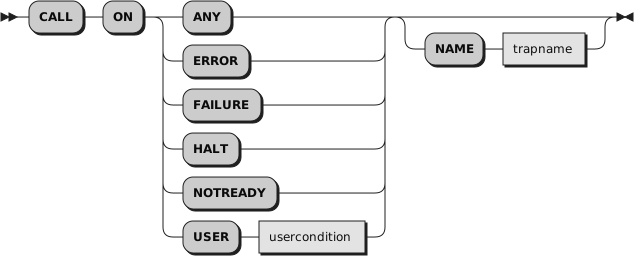
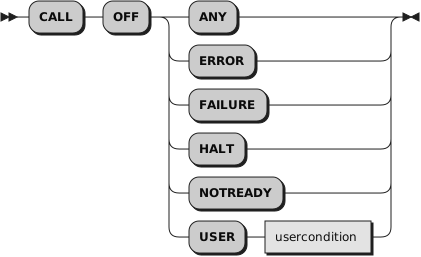
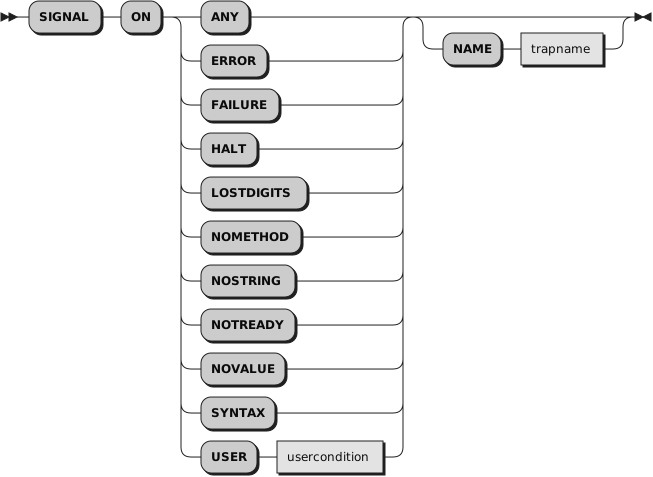
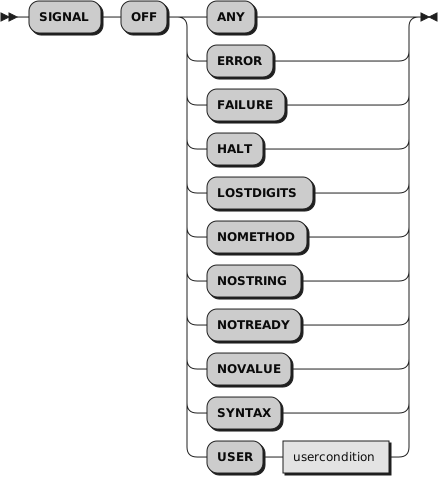
A condition is an event or state that CALL ON or SIGNAL ON can trap. A
condition trap can modify the flow of execution in a Rexx program. Condition
traps are turned on or off using the ON or OFF subkeywords of the
SIGNAL and
CALL instructions.
condition,
usercondition, and
trapname are single
symbols that are taken as constants. Following one of these instructions,
a condition trap is set to either ON (enabled) or OFF (disabled). The initial
setting for all condition traps is OFF.
If a condition trap is enabled and the specified
condition or
usercondition occurs, control passes
to the routine or label trapname
if you have specified trapname.
Otherwise, control passes to
the routine or label usercondition or
condition. CALL or
SIGNAL is used, depending on whether the most recent trap for the condition
was set using CALL ON or SIGNAL ON, respectively.
If you use CALL, the trapname
can be an internal label, a built-in function, or an external routine.
When calling trapname, the current
Condition Object is supplied as an
argument.
If you use SIGNAL, the
trapname can only
be an internal label.
The conditions and their corresponding events that can be trapped are:
ANY
traps any condition that a more specific condition trap does not trap.
For example, if NOVALUE is raised and there is no NOVALUE trap enabled, but
there is a SIGNAL ON ANY trap, the ANY trap is called for the NOVALUE condition.
For example, a CALL ON ANY trap is ignored if NOVALUE is raised because CALL
ON NOVALUE is not allowed.
ERROR
raised if a command indicates an error condition upon return. It is
also raised if any command indicates failure and none of the following is
active:
CALL ON FAILURE
SIGNAL ON FAILURE
CALL ON ANY
SIGNAL ON ANY
The condition
is raised at the end of the clause that called the command but is ignored
if the ERROR condition trap is already in the delayed state.
The delayed state is the state of a condition trap when the condition has
been raised but the trap has not yet been reset to the enabled (ON) or disabled
(OFF) state.
If the package contains an
::OPTIONS ERROR SYNTAX directive and
ERROR is not trapped with CALL/SIGNAL ON/OFF ERROR/ANY, a SYNTAX condition is
raised instead.
FAILURE
raised if a command indicates a failure condition upon return. The condition
is raised at the end of the clause that called the command but is ignored
if the FAILURE condition trap is already in the delayed state.
An attempt
to enter a command to an unknown subcommand environment also raises a FAILURE
condition.
If the package contains an
::OPTIONS FAILURE SYNTAX directive and
FAILURE is not trapped with CALL/SIGNAL ON/OFF FAILURE/ANY, a SYNTAX condition is
raised instead.
HALT
raised if an external attempt is made to interrupt and end execution
of the program. The condition is usually raised at the end of the clause that
was processed when the external interruption occurred. When a Rexx program
is running in a full-screen or command prompt session, the Ctrl+Break key
combination raises the halt condition. However, if Ctrl+Break is pressed while
a command or non-Rexx external function is processing,
the command or function ends.
Notes:
Application programs that use the Rexx language processor might use the
RXHLT exit or the RexxStart programming interface to halt the execution of
a Rexx macro. (See the
Open Object Rexx: Application Programming Interfaces
for details about exits.)
raised if a number used in an arithmetic operation has more digits than
the current setting of NUMERIC DIGITS. Leading zeros are not counted in this
comparison. You can specify the LOSTDIGITS condition only for SIGNAL ON.
If the package contains an
::OPTIONS LOSTDIGITS SYNTAX directive and
LOSTDIGITS is not trapped with SIGNAL ON/OFF LOSTDIGITS/ANY, a SYNTAX condition is
raised instead.
NOMETHOD
raised if an object receives a message for which it has no method defined,
and the object does not have an UNKNOWN method. You can specify the NOMETHOD
condition only for SIGNAL ON.
NOSTRING
raised when the language processor requires a string value from an object
and the object does not directly provide a string value. See
Section 4.2.11, “Required String Values” for
more information. You can specify the NOSTRING condition only for SIGNAL ON.
If the package contains an
::OPTIONS NOSTRING SYNTAX directive and
NOSTRING is not trapped with SIGNAL ON/OFF NOSTRING/ANY, a SYNTAX condition is
raised instead.
NOTREADY
raised if an error occurs during an input or output operation.
See Section 14.5, “Errors during Input and Output”. This
condition is ignored if the NOTREADY condition trap is already in the
delayed state.
If the package contains an
::OPTIONS NOTREADY SYNTAX directive and
NOTREADY is not trapped with CALL/SIGNAL ON/OFF NOTREADY/ANY, a SYNTAX condition is
raised instead.
NOVALUE
raised if an uninitialized variable is used as:
A term in an expression
The name following the
VAR subkeyword of a PARSE instruction
A variable reference in an EXPOSE
instruction, a PROCEDURE instruction, or a DROP instruction
A method selection override specifier in a message term
Notes:
NOVALUE is not raised
for any uninitialized variables in tails in compound variables.
If the package contains an
::OPTIONS NOVALUE SYNTAX directive and
NOVALUE is not trapped with SIGNAL ON/OFF NOVALUE/ANY, a SYNTAX condition is
raised instead.
Example 11.1. NOVALUE not raised for stems
/* The following does not raise NOVALUE. */signalonnovaluea.=0saya.zsay"NOVALUE is not raised."exitnovalue:say"NOVALUE is raised."
You can specify this condition
only for SIGNAL ON.
SYNTAX
raised if any language-processing error is detected while the program
is running. This includes all kinds of processing errors:
True syntax errors
"Run-time" errors (such as attempting an arithmetic operation
on nonnumeric terms)
Syntax errors propagated from higher call or method invocation
levels
Untrapped HALT conditions
Untrapped NOMETHOD conditions
You can specify this condition only for SIGNAL ON.
Notes:
SIGNAL ON SYNTAX cannot trap the errors 3 and 5.
SIGNAL ON SYNTAX can trap the errors 6 and 30 only if they occur during
the execution of an INTERPRET instruction.
raised if a condition specified on the USER option of CALL ON or SIGNAL
ON occurs. USER conditions are raised by a RAISE instruction that specifies
a USER option with the same usercondition
name. The specified usercondition can be
any symbol, including those specified as possible
values for condition.
Any ON or OFF reference to a condition trap replaces the previous state
(ON, OFF, or DELAY, and any
trapname) of that condition trap. Thus,
a CALL ON HALT replaces any current SIGNAL ON HALT (and a SIGNAL ON HALT replaces
any current CALL ON HALT), a CALL ON or SIGNAL ON with a new trap name replaces
any previous trap name, and any OFF reference disables the trap for CALL or
SIGNAL.