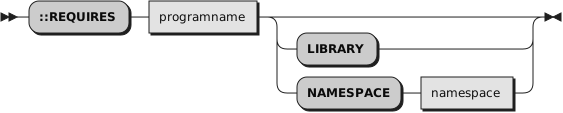
The ::REQUIRES directive specifies that the program requires access to
the classes and objects of the Rexx program
programname.
If the
LIBRARY option is not specified, all public classes and routines
defined in the named program are made available to the executing program. The
programname is a literal string or a symbol that is
taken as a constant. The string or symbol
programname can be any string or symbol that is valid
as the target of a CALL instruction. The program
programname is called as an external routine with no
arguments.
The program is searched for using the
external program search order.
If any Rexx code precedes the first directive in
programname then that code is executed at the
time the ::REQUIRES is processed by the
interpreter. This will be executed prior to executing the main Rexx program in
the file that specifies the ::REQUIRES statement.
If the
LIBRARY option is specified,
programname
is the name of an external native library that is required by this program. The
library will be loaded using platform-specific mechanisms, which generally means
the library name is case sensitive. Any routines defined in the library will be
made available to all programs running in the process. If the native library
cannot be loaded, the program will not be permitted to run. All LIBRARY
::REQUIRES directives will be processed before ::REQUIRES for Rexx programs,
which will ensure that the native libraries are available to the initialization
code of the Rexx packages.
If the
NAMESPACE option is specified,
namespace must be a symbol that is
taken as a constant; a literal string is not allowed.
The
NAMESPACE option attaches the qualifier
namespace to the package loaded by the
::REQUIRES directive.
To distinguish public classes or public routines of the same name in
different ::REQUIRES files, use a namespace-qualified symbol of the form
namespace:class or
namespace:routine.
For details see
Section 1.14, “Namespaces”.
::REQUIRES directives can be placed anywhere after the main section of
code in the package. The order of ::REQUIRES directives determines the search
order for classes and routines defined in the named programs and also the load
order of the referenced files. Once a program is loaded by a ::REQUIRES
statement in a program, other references to that same program by ::REQUIRES
statements in other programs will resolve to the previously loaded program. The
initialization code for the ::REQUIRES file will only be executed on the first
reference.
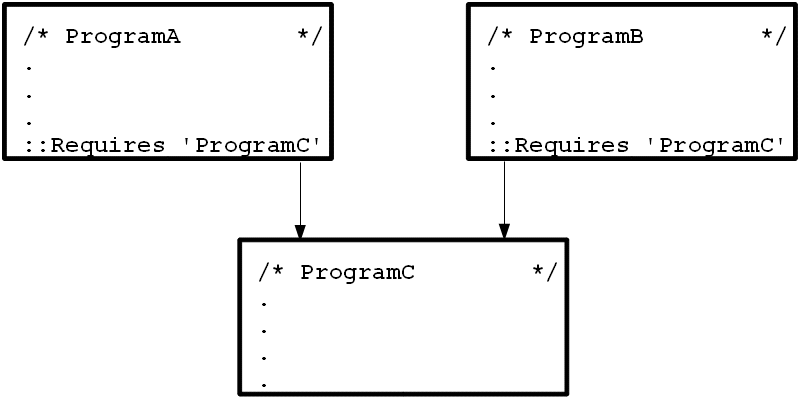
The following example illustrates that two programs, ProgramA and ProgramB,
can both access classes and routines that another program, ProgramC, contains.
(The code at the beginning of ProgramC runs prior to the start of the main
Rexx program.)
The language processor uses local routine definitions within a program
in preference to routines of the same name accessed through ::REQUIRES directives.
Local class definitions within a program override classes of the same name
in other programs accessed through ::REQUIRES directives.
Another directive, or the end of the program, must follow a ::REQUIRES
directive. Only null clauses can appear between them.