
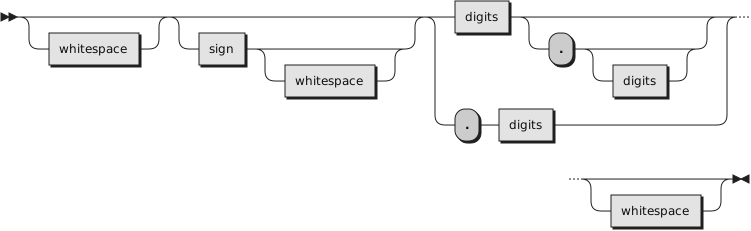
12             /* a whole number                      */
"-76"          /* a signed whole number               */
12.76          /* decimal places                      */
" +  0.003 "   /* blanks around the sign and so forth */
17.            /* same as 17                          */
.5             /* same as 0.5                         */
4E9            /* exponential notation                */
0.73e-7        /* exponential notation                */
+ or
-.
0-9.
+),
subtraction (-),
multiplication (*),
power (**),
division (/),
prefix plus (+), and prefix minus
(-). In addition, it includes
integer divide (%),
which divides and returns the integer part, and
remainder (//), which
divides and returns the remainder. For examples of the arithmetic operators,
see Section 10.2.5, “Operator Examples”.9, but can be overridden
on a source-file basis with the ::OPTIONS directive.
The default setting can be altered with the NUMERIC DIGITS instruction.
Thus, with NUMERIC DIGITS 9, if a result requires more than 9 digits, it is rounded to 9 digits.
For example, the division of 2 by 3 results in 0.666666667.0.1e6 * 1e6 --> 1E+12 /* not 1000000000000 */
1 / 3E10 --> 3.33333333E-11 /* not 0.0000000000333333333 */