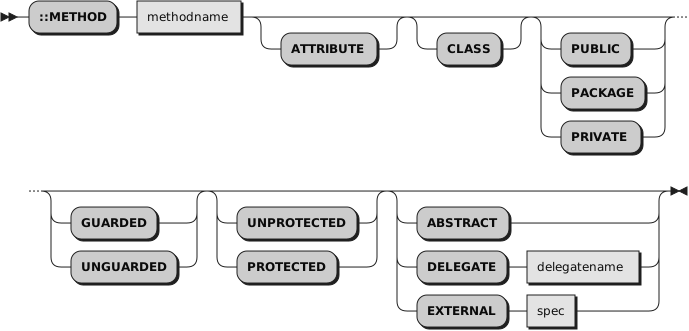
The ::METHOD directive creates a method object and defines the method
attributes.
A ::METHOD directive creates method objects that may be associated with a
class instance. The created method may be from Rexx code, mapped to method in
an external native library, or automatically generated. The type of method is
determined by the combination of options specified.
The
methodname is a literal string or
a symbol that is taken as a constant. The method is defined as
methodname in the class specified
in the most recent ::CLASS directive. Only one ::METHOD directive can appear
for any
methodname in a class.
A ::CLASS directive is not required before a ::METHOD directive. If no
::CLASS directive precedes ::METHOD, the method is not associated with a class
but is accessible to the main (executable) part of a program through the
.METHODS built-in object.
Only one ::METHOD directive can appear for any method name not associated with a class.
If you specify the
CLASS option, the method is a class
method. See
Chapter 4, Objects and Classes. The method is
associated with the class specified on the most recent ::CLASS directive. The
::METHOD directive must follow a ::CLASS directive when the
CLASS option is
used.
If
ABSTRACT is specified, then the created method will be marked as
an abstract method and will raise an error if directly invoked.
For abstract methods there is no method code body following the directive,
so another directive (or the end of the program) must follow the
::METHOD directive.
If
ABSTRACT,
ATTRIBUTE,
DELEGATE, or
EXTERNAL is not specified, the ::METHOD
directive starts a section of method code which is ended by another directive or
the end of the program. The ::METHOD is not included in the source of the
created METHOD object.
Example 3.10. METHOD examples
r = .rectangle~new(20,10)
say "Area is" r~area       /* Produces "Area is 200" */

::class rectangle

::method area              /* defined for the RECTANGLE class */
  expose width height
  return width*height

::method init
  expose width height
  use arg width, height

::method perimeter
  expose width height
  return (width+height)*2
If you specify the
ATTRIBUTE option, method variable accessor methods are
created. In addition to generating a method named
methodname, another method named
methodname= is created. The first method
returns the value of object instance variable that matches the method name.
The second method assigns a new value to the object instance variable.
For example, the directive
creates two methods,
NAME and
NAME=,
equivalent to the following code sequences:
::method name         -- attribute get method
  expose name         -- establish direct access to object variable (attribute)
  use strict arg      -- enforce zero parameters
  return name         -- return object variable's current value

::method "NAME="      -- attribute set method
  expose name         -- establish direct access to object variable (attribute)
  use strict arg name -- retrieve argument and assign it to the object variable
Using the
ATTRIBUTE option is equivalent to using the
::ATTRIBUTE directive.
If you specify the
ABSTRACT option, the method creates an ABSTRACT method placeholder.
ABSTRACT methods define a method that an implementing subclass is expected to provide a concrete
implementation for. Any attempt to invoke an ABSTRACT method directly will raise a SYNTAX condition.
If
DELEGATE is specified, execution of method
name is delegated to object
delegatename.
It is a common design pattern to delegate method execution to an
embedded object.
The directive for such a delegation
::method name delegate delegateName
is equivalent to the following code sequence:
Example 3.11. DELEGATE subkeyword equivalent code
::method name
expose delegateName
forward to(delegateName)
If the
EXTERNAL option is specified, then
spec
identifies a method in an external native library that will be invoked as the
named method. The
spec is a literal string containing a series
of whitespace delimited tokens defining the external method. The first token
must be
LIBRARY, which indicates the method resides in a native library
of the type allowed on a ::REQUIRES directive. The second token must identify
the name of the external library. The external library is located using
platform-specific mechanisms for loading libraries. For Unix-like systems, the
library name is case-sensitive. The third token is optional and specifies the
name of the method within the library package. If not specified, the ::METHOD
name is used. The target package method name is case insensitive.
Example 3.12. METHOD EXTERNAL examples
-- creates method INIT from method RegExp_Init in library rxregexp
::METHOD INIT EXTERNAL "LIBRARY rxregexp RegExp_Init"

-- creates method RegExp_Parse from library rxregexp
::METHOD RegExp_Parse EXTERNAL "LIBRARY rxregexp"
If the
ATTRIBUTE option is specified with the
EXTERNAL option, then two
method objects need to be created. The target method name is appended to the
string "GET" to derive the name of the getter attribute method. To generate the
setter attribute method, the name is appended to the string "SET".
Example 3.13. METHOD EXTERNAL examples
-- maps "NAME" method to "GETNAME and
-- "NAME=" to "SETNAME"
::METHOD name ATTRIBUTE EXTERNAL "LIBRARY mylib"

-- maps "ADDRESS" method to "GETMyAddress and
-- "ADDRESS=" to "SETMyAddress"
::METHOD address ATTRIBUTE EXTERNAL "LIBRARY mylib MyAddress"
You can specify all options in any order.
If you specify the
PACKAGE option, the method
is created with a package-scope, if you specify the
PRIVATE
option, the created method is a private method.
Package-scope and private methods have restricted access rules on how
they can be invoked.
See
Section 4.2.8, “Public, Package-Scope, and Private Methods”
for details of how these methods can be used.
If you omit the
PACKAGE or
PRIVATE option,
or specify
PUBLIC, the method is a public method
that any sender can activate.
If you
specify
the
UNGUARDED option, the method can be called while other methods are active on
the same object. If you do not specify
UNGUARDED, the method requires exclusive
use of the object variable pool; it can run only if no other method that
requires exclusive use of the object variable pool is active on the same
object.
If you specify the
PROTECTED option, the method is a protected
method. (See
Chapter 13, The Security Manager for more information.)
If you omit the
PROTECTED option or specify
UNPROTECTED, the method is
not protected.
If you specify
ATTRIBUTE,
ABSTRACT, or
EXTERNAL, another
directive (or the end of the program) must follow the ::METHOD directive.
It is an error to specify ::METHOD more than once within the same
class and use the same
methodname.