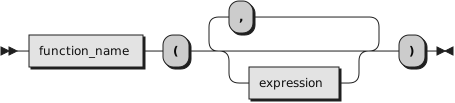
1.11.1. Terms and Expressions
Terms are literal strings, symbols, message
terms and sequences, Array terms, Variable Reference terms, function
calls, or subexpressions interspersed with zero or more operators
that denote operations to be carried out on terms.
Symbols (no quotation marks) are translated to
uppercase. A symbol that does not begin with a digit or a period can be the
name of a variable; in this case the
value of that variable is used. A symbol
that begins with a period can identify an object that the current environment
provides; in this case, that object is used. Otherwise a symbol is treated
as a constant string. A symbol can also be
compound.
An
expression consists of
one or more terms. A
subexpression
is a term in an
expression surrounded with a left and a right parenthesis.
As each term is used in an expression, it is evaluated
as appropriate. The result is an object. Consequently, the result of evaluating
any expression is itself an object
(such as a character string).