You can include
messages to objects in an expression
wherever a term, such as a literal string, is valid. A message can be sent
to an object to perform an action, obtain a result, or both.
A
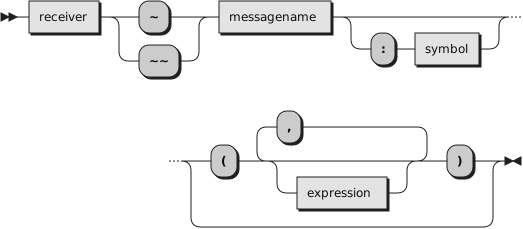
message term can have one of the following forms:
The
receiver is a term (see
Section 1.11.1, “Terms and Expressions” for a definition
of term). It receives the message. The ~ or ~~ indicates
sending a message. The
messagename
is a literal string or a symbol that is taken as a constant. The
expressions (separated by commas)
between the parentheses or brackets are the arguments for
the message. The
receiver
and the argument
expressions can
themselves include message terms. If the message has no arguments, you can
omit the parentheses.
The left parenthesis, if present, must immediately follow a token
(
messagename or
symbol) with no blank in
between them. Otherwise, only the first part of the construct is recognized
as a message term. (A blank operator would be assumed at that point.) Only
a comment (which has no effect) can appear between a token and the left
parenthesis.
You can use any number of
expressions,
separated by commas. The
expressions
are evaluated from left to right and form the arguments during
the execution of the called method. Any ARG, PARSE ARG, or USE ARG instruction or
ARG() built-in function in the called method accesses these objects while the
called method is running. You can omit
expressions, if appropriate,
by including extra commas.
The
receiver object is evaluated, followed
by one or more
expression arguments.
The message name (in uppercase) and the resulting argument
objects are then sent to the receiver object. The receiver object selects
a method to be run based on the message name, and
runs the selected method with the specified argument objects. The receiver
eventually returns, allowing processing to continue.
If the message term uses ~, the receiver method must return a result object.
This object is included in the original expression as if the entire message
term had been replaced by the name of a variable whose value is the returned
object.
For example, the message POS is valid for strings, and you could code:
c="escape"
a="Position of 'e' is:" c~pos("e",3)
/* would set A to "Position of 'e' is: 6" */
If the message term uses ~~, the receiver method need not return
a result object. Any result object is discarded, and the receiver object is
included in the original expression in place of the message term.
account = .object~subclass("Account")~~inherit(.persistent)
/* would set ACCOUNT to the object returned by SUBCLASS, */
/* after sending that object the message INHERIT */
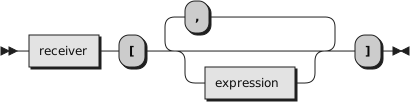
If the message term uses brackets, the message
[] is sent to
the receiver object. (The
expressions
within the brackets are available to the receiver object as arguments.)
The effect is the same as for the corresponding ~
form of the message term. Thus,
a[b]
is the same as
a~"[]"(b).
For example, the message
[] is valid for arrays
(see
Section 5.3.6, “Array Class”) and you could code:
Example 1.18. Arrays
a = .array~of(10,20)
say "Second item is" a[2]   /* Same as: a~at(2)              */
/* or a~"[]"(2)                  */
/* Produces: "Second item is 20" */
A message can have a variable number of arguments. You need to specify
only those required. For example,
"ESCAPE"~POS("E") returns
1.