
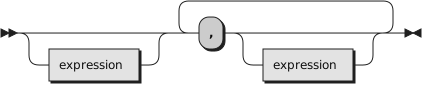
rexx:Array~of(…).
(An Array term will always return an instance of the Rexx-defined
Array class, even if a user-defined class named
Array exists.)
week = "mon", "tue", "wed", "thu", "fri", "sat", "sun"
say week~items "days"                           -- 7 days

say ("here", "we", "go")~makeString(, " ")      -- here we go

iso639 = .Directory~of(("de", "Deutsch"), ("en", "English"), ("fr", "français"))

do list over .environment, .local
  say list~items                                -- 65
end                                             -- 10

say 0~sendWith("MAX", (2, 3, 5, 7, 11, 13))     -- 13

sparse = ,,,0
say "size" sparse~size"," sparse~items "items"  -- size 4, 1 items
.Array~of(…)
would have returned:
say (1, , 3, ,)~size .Array~of(1, , 3, ,)~size  -- 5 3
say (,)~size .Array~of(,)~size                  -- 2 0
call func "uno", 2, "tre"      -- no Array term: three parms
call func ("uno", 2, "tre")    -- Array term: one Array as parm
say (,)~items      -- 0
say (,)~size       -- 2