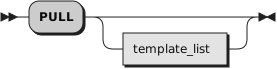
PULL reads a string from the head of the external data queue or, if
the external data queue is empty, from the standard input stream (typically the keyboard).
(See
Chapter 14, Input and Output Streams for a discussion of Rexx input and output.)
It is a short form of the following
instruction:
The current head
of the queue is read as one string. Without a
template_list specified,
no further action is taken and the string is thus effectively discarded.
The
template_list can be a single
template or list of templates separated
by commas, but PULL parses only one source string. Each template consists
of one or more symbols separated by whitespace, patterns, or both.
If you specify several comma-separated templates, variables in templates
other than the first one are assigned the null string. The string is translated
to uppercase (that is, lowercase
a-
z
to uppercase
A-
Z)
and then parsed into variables according to the
rules described in
Chapter 9, Parsing. Use the PARSE PULL
instruction if you do not desire uppercase translation.
If the current
data queue is empty, PULL reads from the standard input (typically, the
keyboard). If there is a PULL from the standard input, the program waits for
keyboard input with no prompt.
Say "Do you want to erase the file?  Answer Yes or No:"
Pull answer .
if answer="NO" then say "The file will not be erased."
Here the dummy placeholder, a period
(
.), is used in the template
to isolate the first word the user enters.
If the external data queue is empty, a line is read from the default input
stream and the program pauses, if necessary, until a line is complete. (This
is as though PARSE UPPER LINEIN had been processed.
For details see
PARSE LINEINThe
QUEUED built-in function
returns the number of lines currently in the external data queue.