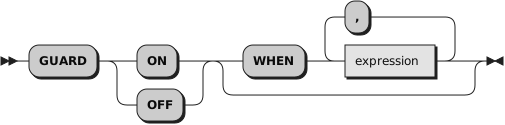
GUARD controls a method's exclusive access to an object.
GUARD ON acquires for an active method exclusive use of
its object variable
pool. This prevents other methods that also require exclusive use of the same
variable pool from running on the same object. If another method has already
acquired exclusive access, the GUARD instruction causes the issuing method
to wait until the variable pool is available.
GUARD OFF releases exclusive use of the object variable pool.
Other methods
that require exclusive use of the same variable pool can begin running.
If you specify WHEN, the method delays running until the
expression evaluates to
.true. If the
expression evaluates
to
.false,
GUARD waits until another method assigns or drops
an object variable used
in the WHEN
expression.
When an object variable changes, GUARD reevaluates
the WHEN
expression. If the
expression evaluates to
.true,
the method resumes running. If the
expression evaluates to
.false,
GUARD resumes waiting.
The condition
expression after a WHEN
can also be a list of
expressions which is
evaluated left-to-right.
Each
expression must evaluate to either
.false or
.true.
Evaluation will stop with the first
.false result and
.false will be
returned as the condition result.
If all of the
expressions evaluate
to
.true, then the condition result is also
.true.
The
expression or list of
expressions
can reference both local and object variables,
but must reference at least one object variable exposed by a
USE LOCAL instruction or an
EXPOSE instruction with a
simple variable name (not a variable in parentheses representing a
subsidiary list of variables).
Example 2.15. Instructions — GUARD
c = .Concurrent~new
c~work

::class Concurrent
::method init
  expose ready
  ready = .false
  reply
  call SysSleep 1 -- long-running initialization
  ready = .true

::method work unguarded
  expose ready
  guard on when ready -- wait until initialized
  say "starting work"
If you specify WHEN and the method has exclusive access to the object's
variable pool, then the exclusive access is released while GUARD is waiting
for an object variable to change. Exclusive access is reacquired before the
WHEN
expression is evaluated. Once the
WHEN
expression evaluates
to
.true, exclusive access is either
retained (for GUARD ON
WHEN) or released (for GUARD OFF WHEN), and the method resumes running.
If the condition expression cannot be met, GUARD ON WHEN puts the
program in a continuous wait condition. This can occur in particular when
several activities run concurrently. See
Section 12.4.3, “Guarded Methods” for more information.