
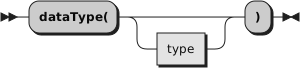
NUM if you specify no argument and the
receiving string is a valid Rexx number that can be added to 0 without error.
It returns CHAR if the receiving string is not a valid number.
.true if the receiving string matches the type.
Otherwise, it returns .false.
If the receiving string is null, the method returns .false
(except when the type is
X or B, for which
dataType returns .true for a null string).
The following are valid types.
You need to specify only the capitalized letter, or 9 for
the 9Digits option.
The language processor ignores all characters following it.Alphanumeric.true if the receiving
string contains only characters from the ranges
a-z,
A-Z, and
0-9.
Binary.true if the receiving string contains only the
characters 0 or 1,
or whitespace.
Whitespace characters can appear only between groups of 4 binary characters.
It also returns .true if string is a null string, which is a valid binary string.
Internal whole number.true if the receiving string is a Rexx whole number that
built-in functions will accept.
Rexx built-in functions internally work with NUMERIC DIGITS 9 for 32-bit systems
or NUMERIC DIGITS 18 for 64-bit systems.
Lowercase.true if the receiving
string contains only characters from the range
a-z.
Mixed case.true if the receiving
string contains only characters from the ranges
a-z and
A-Z.
Number.true if
receiving_string~dataType returns
NUM.
lOgical.true if the receiving string is exactly
0 or 1.
Otherwise it returns .false.
Symbol.true if the receiving
string is a valid symbol, that is, if
SYMBOL(receiving_string)
does not return BAD.
See also Section 1.10.4.4, “Symbols”.
Note that both uppercase and lowercase alphabetic characters are permitted.
Uppercase.true if the receiving
string contains only characters from the range
A-Z.
Variable.true if the receiving
string could appear on the left-hand
side of an assignment without causing a SYNTAX condition.
Whole number.true if the receiving
string is a whole number under the current setting of NUMERIC DIGITS.
heXadecimal.true if the receiving
string contains only characters from the ranges
a-f,
A-F,
0-9, and
whitespace characters (as long as whitespace characters appear only between
pairs of hexadecimal characters). Also returns
.true if
the receiving string is a null string.
9 Digits.true if
receiving_string~dataType("W") returns
.true when NUMERIC DIGITS is set to 9.
Say " 12 "~dataType          -->   "NUM"
Say ""~dataType              -->   "CHAR"
Say "123*"~dataType          -->   "CHAR"
Say "12.3"~dataType("N")     -->    1
Say "12.3"~dataType("W")     -->    0
Say "Fred"~dataType("M")     -->    1
Say ""~dataType("M")         -->    0
Say "Fred"~dataType("L")     -->    0
Say "?20K"~dataType("s")     -->    1
Say "BCd3"~dataType("X")     -->    1
Say "BC d3"~dataType("X")    -->    1
Say "1"~dataType("O")        -->    1
Say "11"~dataType("O")        -->   0
dataType
method tests the meaning or type of characters in a
string, independent of the encoding of those characters (for example, ASCII
or EBCDIC).