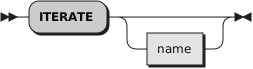
ITERATE alters the flow within a repetitive loop (that is, any DO
construct other than that with a simple DO or a LOOP instruction).
Execution of the group of instructions stops, and control is passed to
the DO or LOOP instruction just as though the END clause had been encountered. The
control variable, if any, is incremented and tested, as usual, and the group
of instructions is processed again, unless the DO or LOOP instruction ends the loop.
The name is a symbol, taken as a
constant. If name is
not specified, ITERATE continues with the current repetitive loop.
If name is specified, it must be the
name of the control variable or the LABEL name of a currently
active loop, which can be the innermost, and this is the loop that is stepped.
Any active loops inside the one selected for iteration are ended (as though
by a LEAVE instruction).
Example 2.22. Instructions — ITERATE
looplabelMyLabelNamei=1to4/* label set to 'MYLABELNAME' */ifi=2theniteratesayiendmyLabelName/* Displays the numbers: 1 3 4*/
Notes:
If specified, name
must match the symbol naming the control variable or LABEL name
in the DO or LOOP clause in all respects except the case. No substitution for compound
variables is carried out when the comparison is made.
A loop is active if it is currently being processed.
If a subroutine is called, or an INTERPRET instruction is processed, during
the execution of a loop, the loop becomes inactive until the subroutine has
returned or the INTERPRET instruction has completed. ITERATE cannot be used
to continue with an inactive loop.
If more than one active loop uses the same name, ITERATE selects
the innermost loop.