
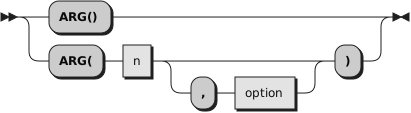
ArrayExists1 if the
nth argument exists; that is, if
it was explicitly specified when the routine was called. Otherwise, it returns
0.
NormalOmitted1 if the
nth argument was omitted; that
is, if it was not explicitly specified when the routine
was called. Otherwise, it returns 0.
/*  following "Call name;" (no arguments) */
Say ARG()         -->    0
Say ARG(1)        -->    ""
Say ARG(2)        -->    ""
Say ARG(1,"e")    -->    0
Say ARG(1,"O")    -->    1
Say ARG(1,"a")    -->    .array~of()

/*  following "Call name 'a', ,'b';" */
Say ARG()         -->    3
Say ARG(1)        -->    "a"
Say ARG(2)        -->    ""
Say ARG(3)        -->    "b"
Say ARG(n)        -->    ""    /* for n>=4 */
Say ARG(1,"e")    -->    1
Say ARG(2,"E")    -->    0
Say ARG(2,"O")    -->    1
Say ARG(3,"o")    -->    0
Say ARG(4,"o")    -->    1
Say ARG(1,"A")    -->    .array~of(a, ,b)
Say ARG(3,"a")    -->    .array~of(b)
ARG(n,"e") returns
1 or 0
if there are no explicit argument strings. That is, it is the position of the
last explicitly specified argument string.